GorillaDesk vs FieldRoutes: which pest control platform wins?
PestGrade is reader-supported. When you sign up for a tool through our links, we may earn a commission — at no cost to you, and it never affects our rankings. How we grade →
The verdict: for solo operators and small crews, GorillaDesk wins — transparent pricing from $49/mo, pest-specific compliance, 14-day trial with no contract. For commercial-heavy operations scaling past 25 techs, FieldRoutes offers enterprise routing depth and commercial account tools — but you’ll need a sales call to find out what you’ll pay.
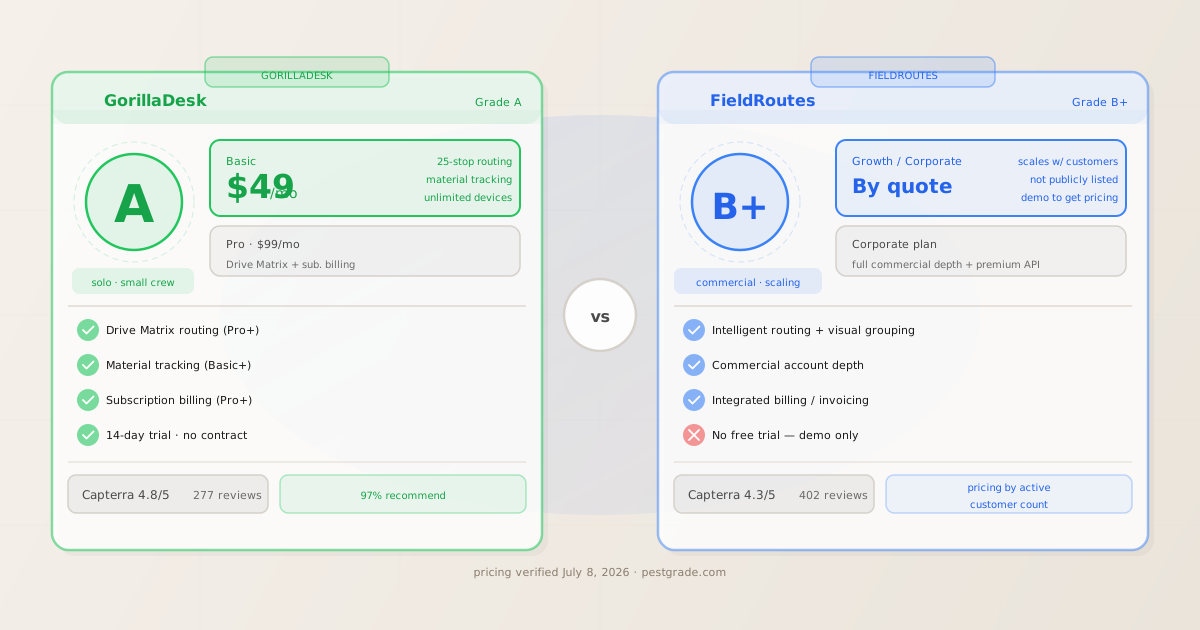
The verdict — scoped by company size
- Best for solo through ~25-tech operations: GorillaDesk — Grade A
- Purpose-built for pest control with published, predictable pricing ($49–$149/mo), material and compliance tracking on the entry plan, and pest-specific workflows throughout. Drive Matrix route optimization unlocks on the $99/mo Pro plan. A 14-day free trial with no credit card and no contract means you can evaluate the fit without a sales conversation. Capterra: 4.8/5 across 277 reviews, 97% recommend (GetApp, verified July 8, 2026).
- Best for commercial-heavy or rapidly scaling operations: FieldRoutes — Grade B+
- A platform built for pest control businesses managing large commercial account books, multi-team routing, and enterprise reporting. Intelligent routing with visual grouping is a genuine differentiator at scale. The trade-off: pricing is quote-only (based on active customer count), there is no free trial, and some users report route optimization as a separately priced add-on rather than a bundled feature. Capterra: 4.3/5 across 402 reviews (verified July 8, 2026).
Both tools are genuinely pest-specific, which puts them ahead of general field-service platforms like Jobber or Housecall Pro for operators who need chemical logs and compliance documentation. The dividing line between them is scale, pricing transparency, and commercial-account depth. PestGrade has no affiliate relationship with either vendor that affects this ranking — see how we grade →
Pricing & contract terms compared
GorillaDesk pricing verified directly from gorilladesk.com/pricing on July 8, 2026. FieldRoutes pricing verified from fieldroutes.com/pricing on July 8, 2026 — no tiers or figures are publicly listed; contact FieldRoutes directly for a quote.
| Plan / term |  GorillaDesk GorillaDesk |
 FieldRoutes FieldRoutes |
|---|---|---|
| Entry tier | $49/mo — Basic (25-stop routing, material tracking, unlimited devices) | not publicly listed (Growth plan — request quote) |
| Mid tier | $99/mo — Pro (Drive Matrix routing, subscription billing, GPS, customer portal) | not publicly listed |
| Top tier | $149/mo — Growth (multi-branch, sales pipeline, custom fields) | not publicly listed (Corporate plan — request quote) |
| Annual option | ~10% savings (e.g. $539/yr for Basic; $1,089/yr for Pro) | not publicly listed |
| Pricing model | Flat monthly per route/plan | Scales with number of active customers |
| Setup / onboarding fee | None — free data migration included | not publicly listed |
| Contract | Month-to-month, no commitment | not publicly listed |
| Free trial | 14 days, no credit card required | No trial — scheduled demo only |
| SMS add-on | $5/mo + usage credits ($50 for 1,000 messages) | not publicly listed |
All figures verified July 8, 2026. GorillaDesk plans are priced per route at the base level; multi-route pricing is not publicly listed. FieldRoutes pricing requires a direct quote — every “not publicly listed” entry above is factual, not a gap in our research.
The transparency gap is the first real difference between these tools. GorillaDesk publishes every tier with the exact monthly price, what’s included at each level, and the annual discount. A pest control operator can fully price-compare GorillaDesk against competitors in under five minutes. FieldRoutes requires a sales call. For an operator evaluating multiple tools under budget pressure, that friction matters: you can’t sanity-check FieldRoutes against your QuickBooks budget without getting into a demo conversation. If you’re a commercial operation where procurement typically involves a vendor demo anyway, this is less of an issue. For solo operators and small crews, it’s a real disadvantage.
Route optimization head-to-head
Both tools offer genuine route optimization — neither is just a map with pins. But they work differently, and the user feedback patterns diverge.
| Routing feature | GorillaDesk |
FieldRoutes |
Category norm |
|---|---|---|---|
| Basic route optimization | ✓ Included (Basic — up to 25 stops) | ✓ Both tiers | Standard |
| Advanced algorithm | ✓ Drive Matrix (Pro+) — optimizes by drive time | ✓ Intelligent routing (both tiers) | Varies |
| Visual route grouping / map view | ✓ Available | ✓ Intelligent Visual Grouping — noted strength | Common |
| GPS tech tracking | ✓ Pro+ | ✓ Included | Common |
| Route optimization pricing | Included in Pro+ ($99/mo) — no routing add-on | Some users report it as a separately priced add-on (GetApp reviews) | Varies |
| Multi-route / multi-team support | Not publicly listed (plans are per-route at base) | ✓ Designed for multi-team operations | Varies |
GorillaDesk’s Drive Matrix algorithm, available on Pro and Growth plans, builds optimized stop sequences using actual drive time — not straight-line distance. For a single-route pest operator running 20–40 stops per day, the difference between a 25-stop basic sort and Drive Matrix can translate to 45–90 fewer minutes on the road. That’s the data operators cite most frequently in reviews when they describe switching on Drive Matrix after starting on Basic.
FieldRoutes’ Intelligent Routing with Visual Grouping is more powerful at the multi-team level. GetApp reviewers describe it as a genuine efficiency gain: the visual grouping lets dispatchers drag-and-drop stops across geographic clusters before finalizing routes, which matters when you’re coordinating five or more field teams across different zones. The catch flagged in multiple reviews: some operators on FieldRoutes found route optimization billed as an add-on rather than included — an important thing to verify directly with FieldRoutes before signing up.
Recurring billing & payments
| Billing feature | GorillaDesk |
FieldRoutes |
Category norm |
|---|---|---|---|
| Subscription / recurring billing | ✓ Pro+ ($99/mo) | ✓ Included | Standard for pest tools |
| Card-on-file / autopay | ✓ Pro+ | ✓ Customer payment portal | Common |
| Invoice via text / email | ✓ All plans | ✓ Noted user strength | Common |
| Quarterly / seasonal schedules | ✓ Subscription billing (Pro+) | ✓ Supported | Standard for pest tools |
| QuickBooks sync | ✓ Pro+ (direct sync) | ✓ Available (manual sync reported by some users) | Common |
| Commission tracking | ✓ Pro+ | not publicly listed | Varies |
Both platforms handle the recurring billing workflows pest control depends on: quarterly service contracts, card-on-file autopay, and automated invoice delivery. GorillaDesk gates subscription billing behind the $99/mo Pro plan, which means a Basic ($49/mo) operator has to manually invoice for recurring accounts. That’s a real constraint if recurring revenue is your primary business model — the upgrade to Pro is the right call for anyone running quarterly billing at any meaningful volume.
FieldRoutes’ billing is noted positively in user reviews, particularly the ability to send invoices via text, email, or mail. The friction point is QuickBooks integration: multiple GetApp reviewers describe the FieldRoutes–QuickBooks sync as requiring manual steps, with some reporting double-billing incidents. This is a pattern across multiple reviews (not a one-off), which means operators who rely heavily on QuickBooks should verify the current integration state directly with FieldRoutes before committing.
Mobile field app & compliance tracking
| Mobile / compliance feature | GorillaDesk |
FieldRoutes |
Category norm |
|---|---|---|---|
| Mobile tech app | ✓ All plans — unlimited devices | ✓ Both tiers | Standard |
| Material / chemical usage tracking | ✓ Basic+ (included at entry) | not publicly listed | Pest-specific standard |
| E-signatures | ✓ Pro+ | not publicly listed | Common |
| Offline capability | Reported as limited by some users | Reported as limited by some users | Varies |
| App stability (user-reported) | 4.7/5 mobile rating on GetApp — well-regarded | Glitches and crashes noted across multiple GetApp reviews | — |
| Online booking widget | ✓ Pro+ | ✓ Both tiers | Common |
GorillaDesk’s mobile app gets a 4.7/5 rating for mobile on GetApp (277 reviews). The key differentiator for pest control specifically: material tracking is included at the entry plan ($49/mo). That means a Basic plan operator can log chemical usage, application rates, and EPA registration numbers in the field without upgrading. For operators who need compliance documentation to satisfy state reporting requirements or commercial customer audits, this is material — most general field-service tools require either a higher tier or a third-party add-on for chemical logs.
FieldRoutes users cite the mobile app as essential to daily operations, but also as a source of frustration: GetApp reviews describe occasional crashes and glitches. This is a recurring pattern across multiple independent reviews, not an outlier complaint. For a business where techs rely on the app to complete service records in the field, app instability has a real operational cost.
Reporting & scaling to commercial
| Commercial / reporting feature | GorillaDesk |
FieldRoutes |
|---|---|---|
| Dashboard reporting | 20+ reports (Basic+) | Real-time data reporting + commercial trend reporting |
| Multi-branch support | Growth plan ($149/mo) | Both tiers (built for multi-location) |
| Sales pipeline / lead management | Growth+ (sales pipeline, custom fields) | Lead management included |
| Premium API access | Zapier integration (Pro+) | Premium API (both tiers) |
| Sentricon integration | not publicly listed | ✓ Listed feature |
| Review generation | ✓ Pro+ | not publicly listed |
This is where FieldRoutes earns its B+ and where the audience split becomes clear. A pest control business running 10 techs across two geographic service areas, with a significant commercial account book, will hit the ceiling of GorillaDesk’s reporting fairly quickly. GorillaDesk’s Growth plan ($149/mo) adds multi-branch support and custom fields, but its reporting depth is designed for single-operator or small-crew use. FieldRoutes is built from the ground up for larger operational complexity: commercial trend reporting, multi-location visibility, and a premium API for integrating with enterprise business systems.
The Sentricon integration is worth flagging for termite operators specifically. FieldRoutes lists it as a feature; GorillaDesk does not publicly document this integration. For a termite business that relies on Sentricon as part of its service delivery, that’s a real FieldRoutes advantage that should be confirmed directly with FieldRoutes during the demo.
What operators love — and what frustrates them
Patterns synthesized from verified reviews on GetApp and Capterra (attribution below). No first-hand use; these are real-operator observations from named review platforms.
GorillaDesk
- What operators love
- Setup speed and ease of use. GetApp reviewers consistently describe GorillaDesk as the easiest pest control platform to get running — “even those less tech-savvy” staff pick it up quickly. Scheduling scores 4.9/5, the highest-rated dimension on GetApp (277 reviews). Operators moving from paper or from general tools cite GorillaDesk as the first software that didn’t require a week of onboarding.
- Customer support responsiveness. Support scores 4.8/5. The pattern across reviews: fast response during business hours, knowledgeable staff, and proactive help during the trial and early adoption period. For a small operator without an IT department, that support quality is often the deciding factor between sticking with a tool and churning.
- Automation reducing admin time. Automated email and SMS notifications for appointment reminders, service confirmations, and payment follow-ups are cited by multiple reviewers as eliminating a meaningful chunk of daily office work. This matters most for solo operators who are also the dispatcher and accountant.
- What frustrates them
- Feature gating at lower tiers. The most common frustration: subscription billing, Drive Matrix routing, and customer portal all require the $99/mo Pro plan. For an operator on the $49/mo Basic plan who grows to the point of needing those features, the upgrade jump is a meaningful cost increase. Some reviewers wish more features were bundled into Basic.
- Integration depth. A subset of reviewers note limitations in third-party integrations beyond QuickBooks and Zapier. For operators who have existing CRM or enterprise tools they need to connect, GorillaDesk’s integration surface is narrower than FieldRoutes’ premium API.
FieldRoutes
- What operators love
- Intelligent Routing and Visual Grouping. GetApp reviewers cite this as FieldRoutes’ strongest feature: the ability to see geographic clusters visually, drag routes across teams, and finalize optimized schedules before dispatch. At multi-team scale (five or more route vehicles), this visual layer genuinely speeds up morning dispatch in a way that a list-based sorter cannot.
- All-in-one platform depth. Operators running large commercial books value that scheduling, routing, billing, customer management, and service history live in a single system — avoiding the data-sync overhead of connecting multiple point tools. Invoice delivery via text, email, or mail is frequently cited as saving office staff meaningful time on collections.
- Support when it works well. Multiple reviewers describe FieldRoutes’ support team as “prompt and knowledgeable.” For complex issues on a commercial-scale operation, the quality of that support matters more than at the solo-operator level.
- What frustrates them
- Route optimization add-on costs. A recurring complaint in GetApp reviews: some operators found that route optimization was priced as a separately billed add-on rather than included in their base plan, and that the distance calculations used a “as the crow flies” approximation rather than actual driving distance in some cases. This is a direct contrast to GorillaDesk, where Drive Matrix is a flat-rate Pro-plan feature with no separate routing charge.
- Mobile app instability. Despite calling the app essential, multiple reviewers describe “occasional glitches and crashes.” For a business where techs record service details and collect signatures in the field, app reliability is not a minor issue. This pattern appears consistently enough across independent reviews to flag it as a real risk to evaluate during a FieldRoutes demo.
- QuickBooks integration friction. Reviewers describe the FieldRoutes–QuickBooks integration as requiring manual sync steps, with some reporting double-billing incidents. This is a pattern (not a one-off) and should be probed specifically in the sales process if QuickBooks is core to your accounting workflow.
- Support inconsistency. Alongside positive support experiences, a subset of reviewers report waiting “days, weeks, and even months” for issue resolution. The variance in support quality suggests the experience is team- or issue-dependent at FieldRoutes in a way that GorillaDesk’s reviews do not reflect.
Sources: GetApp (gorilladesk.com listing, fieldroutes.com listing); Capterra pest-control-software category page. Verified July 8, 2026. All feedback is attributed, pattern-level synthesis — not individual quotes reproduced verbatim.
Right for / wrong for
| Situation | GorillaDesk |
FieldRoutes |
|---|---|---|
| Solo operator or owner-operator | ✓ Strong fit — easy to set up, affordable, no contract | ✗ Overbuilt for solo; pricing opacity makes cost evaluation hard |
| Small residential crew (2–10 techs) | ✓ Best fit — Pro plan covers routing, billing, compliance | ✗ Possible fit but no trial to test, pricing by quote |
| Mid-size (10–30 techs, mixed accounts) | ✓ Growth plan covers multi-branch and sales pipeline | ✓ Growth plan built for this scale |
| Commercial-heavy operation (50+ accounts) | Possible but reporting depth may limit at scale | ✓ Best fit — commercial trend reporting, multi-team routing |
| Termite (Sentricon integration needed) | Not publicly listed | ✓ Sentricon integration listed |
| Budget-constrained startup | ✓ $49/mo entry with free migration and no setup fee | ✗ No transparent pricing to compare against budget |
| Operators requiring QuickBooks reliability | ✓ Direct sync on Pro+ (consistent user reports) | Verify carefully — manual sync and double-billing reported |
Our pick for solo and small-crew operators: GorillaDesk
Transparent $49–$149/mo pricing, pest-specific material tracking on the entry plan, Drive Matrix routing on Pro, and a 14-day trial with no contract. For operators who need to compare costs before committing — which is most operators — GorillaDesk is the easier, lower-risk starting point.
PestGrade is reader-supported. When you sign up for a tool through our links, we may earn a commission — at no cost to you, and it never affects our rankings. How we grade →
Our pick for commercial-heavy or scaling operations: FieldRoutes
If you’re running 50+ active accounts, multiple field teams, and need enterprise-grade multi-team routing with visual grouping, commercial trend reporting, and a premium API, FieldRoutes is built for that scale. Request a demo to get pricing and verify route optimization is included in the base plan — not billed as an add-on.
PestGrade is reader-supported. When you sign up for a tool through our links, we may earn a commission — at no cost to you, and it never affects our rankings. How we grade →
Not sure which fits your situation? See our full small-business comparison or read how we grade →
Last verified: July 8, 2026. Pricing figures verified directly from gorilladesk.com/pricing and fieldroutes.com/pricing on July 8, 2026. User feedback patterns synthesized from verified reviews on GetApp and Capterra (attribution in the operator feedback section). This assessment is based on public demos, vendor documentation, and verified user reviews — not hands-on use in a live pest control business. PestGrade builds none of the tools it grades. How we grade →
Frequently asked questions
Is GorillaDesk or FieldRoutes better for a small pest control business?
GorillaDesk is the better fit for most small pest control businesses (1–25 techs). Transparent pricing from $49/mo, material tracking at the entry level, and a 14-day no-contract trial make it easy to evaluate and affordable to start. FieldRoutes prices by quote and requires a demo, which is a meaningful friction point for operators comparing options under budget pressure.
How does FieldRoutes pricing work?
FieldRoutes does not publish pricing on its website. According to its pricing page (verified July 8, 2026), the monthly subscription scales with the number of active customers. Two packages exist — Growth for small businesses and Corporate for scaling operations — but specific figures require contacting FieldRoutes directly or booking a demo. Budget accordingly for a vendor conversation before you can compare costs.
Does FieldRoutes have a free trial?
No. FieldRoutes does not offer a free trial. Access is through a scheduled demo, which FieldRoutes attributes to the platform’s highly customizable nature. GorillaDesk offers a 14-day free trial with no credit card required and no contract.
What is Drive Matrix routing in GorillaDesk?
Drive Matrix is GorillaDesk’s advanced route optimization algorithm, available on the Pro plan ($99/mo) and Growth plan ($149/mo). It builds optimized stop sequences based on actual drive time, not straight-line geographic distance — a meaningful distinction for a pest operator running tight residential schedules. The Basic plan ($49/mo) includes routing for up to 25 stops, but Drive Matrix is Pro-only.
Who should choose FieldRoutes over GorillaDesk?
FieldRoutes suits commercial-heavy or rapidly scaling pest businesses — typically those running 50+ active accounts, coordinating multiple field teams, needing enterprise-grade visual routing, commercial trend reporting, and a premium API. Operators at that scale are usually past the point where a transparent per-month price is the primary concern; they need capability that matches operational complexity. Solo operators and small residential crews will almost always be better served by GorillaDesk.